
Black History Month hunger relief is about honoring lived history, resilience, and the ongoing work of caring for one another. Armistead’s life reflects this.
On a Saturday morning, with temperatures hovering around 25 degrees, Nashvillians lined up for a Second Harvest Mobile Pantry. Among them was Armistead — whose life reflects the long arc of Black history in Nashville.
The boxes that day held familiar staples along with dairy, eggs, and shelf-stable pantry items to help families through the winter. For Armistead, this moment represented more than food.
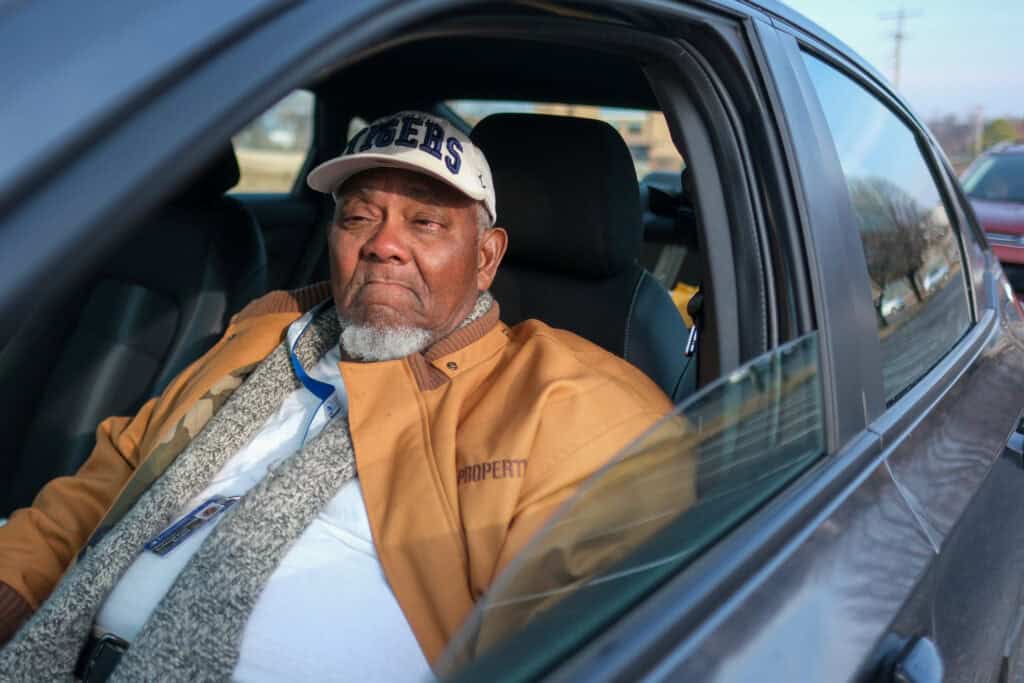
It reflected community, dignity, and the belief that no one should be left behind.
Just three months earlier, Armistead arrived back in Nashville from Houston. He felt compelled to return to Middle Tennessee. He had gone to school here and had family here. That family had since passed. He had lost three brothers and two sisters, all here in the city he still calls home.
With nowhere to stay, Armistead slept in his car.
“I slept in that car for almost three and a half months,” he said. Even now, he can still hear the rain hitting his car roof when he lies down at night.
The strain took a toll on his health. His legs began to swell badly, and a visit to the hospital led to medication meant to reduce the fluid. But without a stable place to rest, the swelling never fully went down. Compounding it all, Armistead was still recovering from a hip replacement, his cane never far from reach.
“I never thought I’d end up back in Nashville like this,” he said. “Nashville is my home. I just never thought I’d be homeless here.”
Armistead is 82 years old and holds two degrees from Tennessee State University, a cornerstone of Black education and leadership in this city. When asked how someone with his background could experience homelessness, his answer is simple.
“How did the man end up blind?” he said. “He was born that way. Sometimes things just happen.”
Eventually, Armistead reached out to the pastor at the church hosting the distribution. That call changed everything. Through church and community connections, he was able to move into assisted living and receive the stability he needed.
Years earlier, while living in Houston, Armistead faithfully sent monthly checks to that same church in Nashville. When he needed help, the community he had supported stepped forward in return — a powerful example of Black History Month hunger relief in action.
Life at Schrader Lane has brought small but meaningful moments of kindness. While helping in the community garden one day, a woman noticed the bed he had been sleeping on — a worn mattress that Armistead had reinforced with a wooden board to keep it from sinking. Without hesitation, she offered to help.
“She said, ‘Sir, you need a bed, not a board,’” Armistead recalled.
That Saturday, she took him to a mattress store and bought him a new bed.
“I had never seen her before in my life,” he said. “She paid $1,000 for that bed. I was just thankful I wasn’t sleeping on that hard mattress anymore.”
At 82, Armistead doesn’t ask for much. Instead, he focuses on others.
“A lot of people don’t have cars,” he said. “Car notes are running $700 a month. But people have to eat first.”
After the distribution, Armistead plans to share part of what he receives with people experiencing homelessness in the South Nashville neighborhood where he grew up.
“When you’re hungry, it doesn’t matter what color you are or where you’re from,” he said. “When you’re hungry, you’re hungry.”
Armistead’s life spans decades of service. As a young man, he marched alongside Dr. Martin Luther King Jr., answering the call for equality at a time when doing so required courage, sacrifice, and an unshakable belief in a more just future. Armistead did not just learn about Black history in schools or from his family.
He lived it.
Later, he worked at Fort Campbell with the 101st Airborne, teaching reading, writing, and math to soldiers. There, he saw Second Harvest support military families long before he ever imagined standing in line himself.
“I never thought I’d be here,” he said. “I had degrees. I had jobs. But you get a blessing so you can take that blessing to somebody else.”
As the line slowly moved forward, Armistead looked around at his fellow neighbors.
“These aren’t greedy people,” he said. “These are needy people. When folks line up at five in the morning and it doesn’t open until nine, that tells you something.”
For Armistead, the box of food he receives represents the chance to keep giving — even now.
“I’m just a steward,” he said. “A doorkeeper. That’s about all I can do. And I’m thankful I can still do that.”